✦ Topcasino’s


























Bitcoin and Online Gambling: How Cryptocurrency Changed the Deposit Desk
Bitcoin has travelled a long way from its early reputation as a niche technical experiment. For online gambling players, it has become a familiar deposit option, and the reason is not hard to find. Gambling transactions are often treated differently by banks and card issuers, so a payment that should take seconds can be declined, delayed, or questioned. Crypto offers another route. Instead of relying on a card network or a traditional bank transfer, a player can move value through a digital wallet. That does not make every transaction effortless, and it does not remove risk, but it helps explain why Bitcoin became so visible on casino deposit pages. The rise of crypto as a deposit tool is less about hype than about solving a payment problem that many players recognise.
Why Gamblers Embraced Bitcoin
Conventional payment methods can be fragile in the online gambling space. Some banks and card issuers refuse to honor gambling transactions, while others apply extra checks that slow everything down. That friction creates a gap. Bitcoin filled part of it because it does not depend on a central bank or card processor to authorize a payment. Value moves peer to peer, and the transaction is recorded on a public ledger. For players, the appeal is usually practical rather than ideological. They want a deposit method that behaves consistently, provided the casino accepts it and the player follows the rules. For operators, accepting crypto can reduce reliance on payment partners that are uncomfortable with gambling. The result can feel more like sending a message than waiting for a bank approval, at least when the process is set up well.
How a Crypto Deposit Actually Works
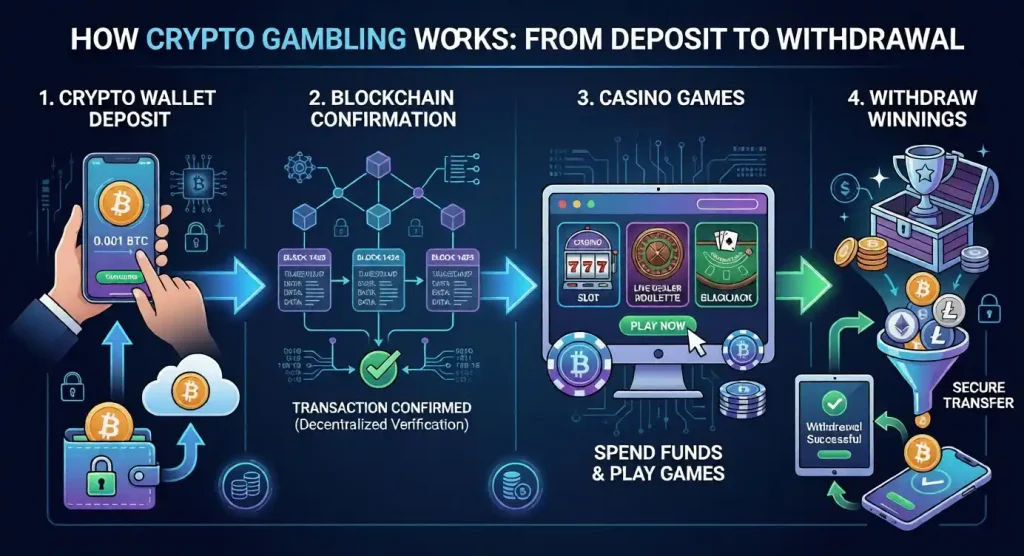
The mechanics are easier to understand once the jargon is stripped away. A player installs a wallet on a computer or phone, and the wallet generates an address. That address acts as a receiving point. The casino supplies an address, the player sends bitcoin to it, and the transaction is broadcast to the network. Miners confirm pending transactions and arrange them in a chronological order, which is how the system maintains a consistent record of balances. When the casino’s required number of confirmations is reached, the deposit is credited according to its policy. The detail that matters most is control. The player initiates the send, so a wrong address, an unsupported coin, or a missing payment reference can create problems. Copy, check, and verify before confirming.
The Price Is Part of the Package
Bitcoin is not a stable token. Its value floats according to supply and demand, and no central authority can flood the market with new coins to hold the price at a chosen target. That is part of its design, and part of its risk. In 2013, one bitcoin climbed almost sevenfold between April and November, reaching roughly $380. A player who deposits and leaves a balance in crypto is therefore exposed to price swings. A casino may credit the equivalent value at the time of receipt, but the amount can move before withdrawal or conversion. Some players accept that volatility as a trade-off for speed and flexibility. Others prefer to convert funds promptly or use a service that settles in local currency.
Speed, Reliability and the Trust Question
The strongest practical argument for Bitcoin is that it can be quick and dependable when the receiving casino has a clear process. There is no card issuer waiting to approve or decline a gambling charge, and no bank branch involved in the transfer. But speed is not guaranteed. Network congestion can delay confirmations, and a casino may set a higher confirmation threshold for larger deposits. Trust also cuts both ways. A player must trust the wallet, the exchange or service used to obtain coins, and the casino’s deposit policy. The casino, in turn, must manage compliance and security. Bitcoin does not erase oversight. It shifts where the checks happen. Players should read the deposit terms, understand what happens if a transaction is sent incorrectly, and keep records. For operators, clear terms and consistent handling matter as much as the technology itself.
What Players Should Check Before Sending Coins
Before using any crypto deposit method, confirm that the casino supports the specific asset and network. Bitcoin is not the same as every other digital coin, and sending the wrong one can lead to loss. Check the minimum deposit, the confirmation requirement, and whether the casino accepts deposits from the player’s jurisdiction. Use a wallet you understand, and test with a small amount first if the option is available. Keep transaction records and screenshots. Avoid sending from a service that may block gambling-related transfers. Also think about withdrawal rules. A fast deposit is less useful if withdrawals are slow or restricted. Treat crypto like any other payment method, with the same attention to terms and security. If anything looks unclear, ask support before sending, not after.
Bitcoin’s rise in online gambling came from a real gap. Traditional payment systems often make gambling deposits awkward, while crypto offers a direct digital route. That route brings speed and flexibility, but also price swings, confirmation delays, and responsibility on the player. Used carefully, Bitcoin can be a practical deposit option. Used carelessly, it can turn a simple deposit into a costly mistake. The key is understanding the mechanics before pressing send. It is a tool, not a shortcut around basic financial hygiene.

Nog geen reacties. Deel als eerste je ervaring.